2021 Webcam Survey

Meeting on Camera During the Pandemic

Who is exhausted, who is engaged after almost a year of WFH.
Editor’s Note (2026): This study was conducted during the rapid rise of remote work in early 2021. While workplace practices have evolved significantly since then, many of the findings around meeting overload, collaboration norms, and digital exhaustion remain highly relevant today.

Introduction

“Zoom fatigue” became one of the defining workplace phrases of the pandemic. But was the problem really video meetings — or something larger? In early 2021, Virtira surveyed more than 1,700 employees, managers, and executives across industries to better understand the growing exhaustion surrounding virtual meetings, webcam expectations, and remote collaboration.
What we found challenged many of the assumptions dominating workplace conversations at the time. The issue wasn’t simply cameras, remote work, or introverts struggling online.
The data pointed to broader problems: meeting overload, poor facilitation, unclear workplace norms, lack of autonomy, and management practices that failed to adapt to distributed work.

Beyond “Zoom Fatigue”

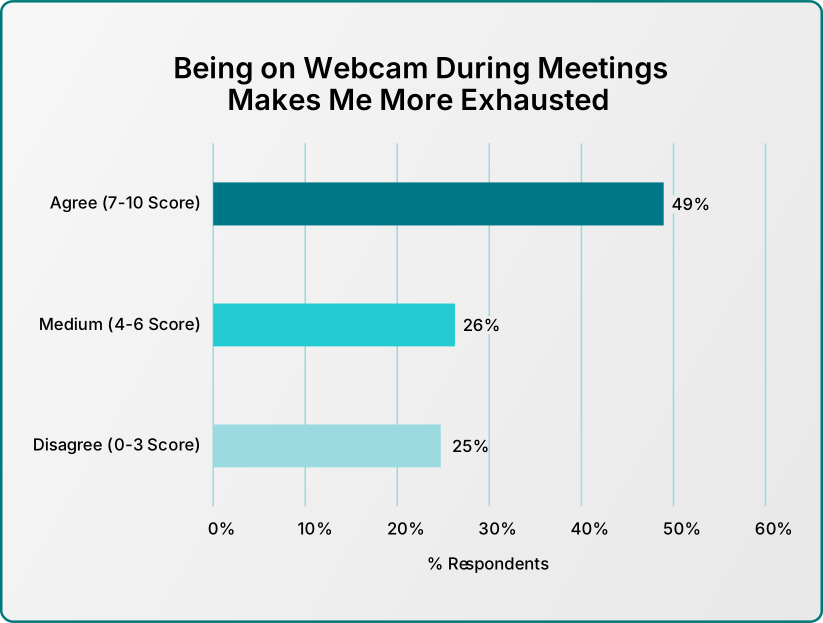
One of the study’s clearest findings was that exhaustion was rarely caused by webcams alone.

Employees who reported the highest fatigue levels were often dealing with a combination of factors: excessive meeting volume, back-to-back scheduling, pressure to remain constantly visible online, and collaboration practices that left little time for focused work.

At the same time, many respondents reported positive experiences with remote work — including greater flexibility, reduced commuting stress, and improved productivity when meetings were well-structured and expectations were clear.

Some employees were exhausted. Others were thriving.

The difference often came down to leadership practices, meeting culture, and how organizations adapted their workflows for distributed work.

While the study was conducted during the rapid rise of remote work, many of these findings remain highly relevant today as organizations continue to navigate hybrid work and increasing digital collaboration demands.

Recommendations

Data, not assumptions, should be driving remote work policies, especially with remote work, because doing it and managing it is still new for the majority of the workforce. Within the survey responses, the comments indicated that for many people, being on webcam increases distraction, makes it difficult to focus or concentrate due to the sensory overload or viewing people on screen, and many reported feeling self-conscious having themselves or their home spaces viewed by others.
  • Video is best used to connect employees in small groups, one-on-one meetings or for the first 2-3 minutes of larger meetings for everyone to say hello. Even in this context, many people are still uncomfortable with being on video, and managers and HR should work with them to determine the root cause and adjust their work situation where possible. Being on camera should be up to the employee.
  • Beyond the presenter or the leader of the call, there is no indication that large meetings, with a screen of talking heads has any advantage over audio and may increase distraction and participant anxiety.
  • Recognize that peer pressure is a key driver of camera use, especially in younger workers, even where it is not required by management or the organization. Training and communications need to be introduced to make staying off-camera.
    • Meetings are not a substitute for informal office chats or a “water cooler.” Businesses need to introduce and train managers and employees on the use of collaboration workspaces so they can do informal updates synchronously and packing extra people into a call when they don’t need to be there sucks time and productivity. Invest in good meeting notes with a meeting recording so they can quickly update themselves on what they need to know and have more uninterrupted work time.

“If I could, I would never turn on my webcam. I am typically far more productive when it’s voice & screen sharing only.”


(Age 35 to 44, Male, $150k+, Introvert)

The Survey

Virtira surveyed over 2,500 executives, managers, and employees in various WFH, commuting, and flex work styles between January 21st and February 8th, 2021.

We also tested for introversion/extroversion to understand if this is a factor. Respondents were from public and private companies across all ages and incomes through two third-party independent online platforms.

Follow-up surveys were sent to over 500 respondents to further clarify some responses. The overall margin of error of ±2.37% at a 95% confidence level is based on 1710 net responses.

Inform your remote work policies with

The Webcam Survey.

Productivity suffers when we exhaust our employees. In the new normal, are we setting remote teams up for success with the constant on-camera meetings or failure by fatigue?